Is AI Creative?
This article explores the multidimensional nature of creativity through the various ways it can be defined as well as its temporal and cultural qualities. By Lisa Talia Moretti for Charismatic.ai.
The research finds that there's no universally accepted definition of creativity and that attempts to answer the question “Is AI Creative?” based on outputs alone undermines the complexity of the creative process as well as the human effort and data that is needed for these products to function. Drawing parallels with the phenomenon of spirit mediums of the 1800s, when new technology was imbued with supernatural qualities, the article discusses that we might be similarly overselling AI's creative capabilities today. Rather than debating whether machines can be creative, the article argues we need a new library of metaphors, similes and questions for discussing the differences between human and computational creativity. The article concludes with a provocation, proposing a new metaphor by which to describe generative AI. Generative AI is not a tool but a medium.

Why This Question Is Worth Asking
In the process of conducting research on how AI is impacting creativity and creative communities, we’ve bumped up against a few questions that get asked repeatedly. Some of these questions, like those relating to the evolving AI regulatory landscape, how creatives are using AI products in their work and how AI products are perceived and experienced by creatives, we have addressed in previous articles.
But there is another question that comes up again and again – Is AI Creative? [1]
When you type this question into a search engine, so much content is returned that we strongly considered not dedicating any more time, or content, to answering it. But then we reconsidered and decided to write something. Why?
Because implied within the question is that a machine not only is intelligent but is capable of creative intelligence; a domain that was once thought to be exclusively carved out for humans and animals, not mechanical objects.
The second reason we decided to write something is because a second topic of discussion seems to have morphed from this original question. Generative AI products, which are capable of producing a variety of media as outputs, now come with a promise of “democratising creativity.”[2] The implication here is not that the machine is creative, but that it will make everyone creative.
This article will attempt to respond to both these implications as succinctly as possible.
Starting With Definitions
The easiest way to answer if X is Y, is by looking at the criteria that defines Y and then determining if X meets that criteria. The difficulty in trying to answer the question of Is AI Creative? is that a globally recognised definition of creativity doesn’t exist. [3] One could argue that up until now, we didn’t need one because human creativity wasn’t under threat or had a competitor.
Take for example, two different dictionaries published by the same institution. A definition of creativity from the Cambridge Advanced Learner's Dictionary & Thesaurus connects creativity to ideas – “the ability to produce or use original and unusual ideas.” [4] However the boundaries of creativity extend if you look up its definition in the Cambridge Academic Content Dictionary to include the act of creation – “the ability to produce original and unusual ideas, or to make something new or imaginative.”
Interestingly, if one had to replace ‘or’ with ‘and’ a new definition begins to emerge; “the ability to produce original and unusual ideas, and to make something new or imaginative.” This definition now reads like a very short explainer of how creativity is shepherded into the world. The definition is no longer just defining a product (“ideas” or “something” that has been made) but a process.
Focusing definitions of creativity on outputs has been criticised and alternatives have been suggested. For example, in a paper published in 2023, academics Green, Beaty, Kenett, and Kaufman write that creativity is often defined by what is produced.[5] They write about the limitations of this approach and outline how creativity is not just a series of products, but a process that current definitions often ignore or exclude. In their paper, they develop a “process definition of creativity” that isn’t dependent on “whether or not a goal is actually achieved.” They propose that “creativity is defined as internal attention constrained by a generative goal.”
Regardless of which of the above definitions you favour, both output-centric and process-centric definitions of creativity refer to activities that one has to engage in with intention. If you’re a Cognitive Scientist, you’d say otherwise.
Creativity Is Already Democratised
In her paper Creativity and Artificial Intelligence (1998), Research Professor of Cognitive Science Magaret Boden defines creativity as a feature of human intelligence that is needed for everyday tasks.
“Creativity is not a special “faculty”, nor a psychological property confined to a tiny elite. Rather it is a feature of human intelligence in general. It is grounded in everyday capacities such as the association of ideas, reminding, perception, analogical thinking, searching a structured problem-space, and reflective self-criticism. It involves not only a cognitive dimension (the generation of new ideas) but also motivation and emotion, and is closely linked to cultural context and personality factors.”
Based on Professor Boden’s definition, saying that generative AI products will democratise creativity is total nonsense, because it already is democratised.
Reviewing the above, we now have a cluster of different definitions of creativity to work with from producing and using ideas, making something new or imaginative, the process one engages in to achieve a goal, and a feature of human intelligence. So, Is AI creative? If you wanted to answer this question very simply, you could say ‘well that depends on what definition of creativity you choose to use.’
Some may argue that after being prompted, activities like generating new ideas and making something new are within the capability of today’s generative AI tools like ChatGPT, Bard, Stability, Anthropic, Firefly and others. They are able to go through a codified process by which they are constrained in some way to generate an output. So based on the definitions of creativity being “the ability to produce original and unusual ideas, or to make something new or imaginative”, AI is creative.
However, there are two crucial points that need to be made, and very quickly.
These products are not out in the world experiencing it. They require human intervention in order to work – “After being prompted” is the operative phrase here. There is also an enormous dataset, hidden from view but absolutely there, composed of human-created media that is unseen but essential for the system to function. Outputs that are generated by an AI product are very much powered by recorded human activity and intervention.
The second crucial point to make is that outputs aren’t just labelled ‘creative’ because they exist. For something to be called ‘creative’, someone has to evaluate it and make that determination.
Typically, definitions help us describe something but they don’t provide any acceptance criteria. They don’t help us make judgements on what is good, bad or even acceptable. So for example, is an idea creative if it is new or imaginative but bad? What about if it’s outright rejected?
Creativity’s Temporal and Cultural Qualities

L'Assiette bleue by Cezanne, Sotherby's
The official Paris Salon rejected the painter Paul Cézanne’s submissions each year from 1864 to 1869. His work was rejected again from 1876 to 1879. In 1882, the jury of the Paris Salon accepted his work for the first and only time. That’s an 18 year wait for approval during which time he exhibited elsewhere and gained support from a few critics.[6] Cézanne’s L'Assiette bleue (1879), painted during a year he was rejected from the Paris Salon, sold for US$6,079,500 in November 2023 at a Sotheby’s auction.[7] It feels absurd to say that Cézanne’s works, an expression of his creativity, were once deemed not good enough to be exhibited but based on historical fact, it’s true. To modernize and relativise this example, if a film studio puts out a new comedy and nobody laughs, is it a failed creative endeavor or would we say it’s not creative? What if the work becomes a cult classic 20 years later? These additional dimensions lead us into new territory, one where definitions alone aren’t enough. The acceptance criteria that are in place, who owns the acceptance criteria and the wider context that acts as the background from which the criteria emerge and against which the work is being judged matters hugely. And this provides us with another reason it’s so difficult to define creativity, because of the temporal and cultural qualities ascribed to it. To go further, we could then say that like beauty, creativity isn’t just in the eye of the beholder but is socially defined and evaluated.
Trying to define AI as creative using a process-centric definition is problematic too. Because quite simply, we have no idea what the process is. “If we open up ChatGPT or a system like it and look inside, you just see millions of numbers flipping around a few hundred times a second. And we just have no idea what any of it means,” said Sam Bowman – an AI Scientist who leads the research division at Anthropic which is focused on technical AI safety. He is also an Associate Professor at New York University.[8] As noted in MIT Technology Review, “This highlights a remarkable fact about deep learning, the fundamental technology behind today’s AI boom: for all its runaway success, nobody knows exactly how—or why—it works.” In the same article, Mikhail Belkin, a computer scientist at the University of California, San Diego is quoted as saying, “Obviously, we’re not completely ignorant, but our theoretical analysis is so far off what these models can do. Like, why can they learn language? I think this is very mysterious.” [9]
Mysterious indeed. Like creativity itself.
Mechanical Mockingbirds
Rather than being creative, is generative AI simply mimicking creativity? Are generative AI products mechanical mockingbirds instead of creative machines?[10] After all, as their name suggests, large language models (LLMs) are modelling language, not creativity. However, because language forms a key component of creativity, LLMs are perceived to be performing creative tasks in the same way humans do.
When you try to start answering this question, one thing starts to become clear fairly quickly; trying to answer the question Is AI Creative? is a sure way of tying yourself into semantic knots. Is this a case of anthropomorphism gone rogue or are the techno utopians attempting to ascribe a greater power to a technology that isn’t really there? We have a history of doing both. Anthropomorphism is an ability humans have to perceive the presence of human qualities in non-human entities. This evolutionary response helps us make sense of the world but also crucially it helped to teach us how to predict what might happen or how things work. Humans who were skilled at social interaction were more likely to survive. Knowing who you could trust to help or predicting who, or what, you should stay away from was a matter of life or death. As a result, spotting the signs of intention and agency is hard-coded into us, and we see these signs everywhere, not just in other humans. Nothing is immune – clouds, the moon, your goldfish, the foam on a morning cappuccino, a chatbot.[11]
We could very well be seeing something that really isn’t there.
Belief Collides With Trend, Technology and Money
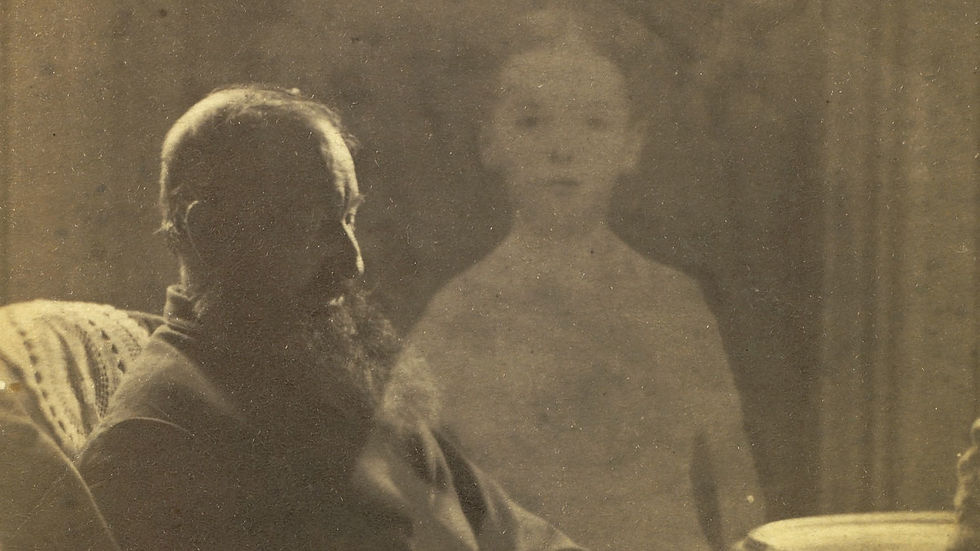
“Unidentified Man Seated with a “Spirit””, J. Paul Getty Museum, Los Angeles, CA, USA
In the 19th century, deadly epidemics, high child mortality rates and two wars – Civil War and the First World War – collided with a newly invented medium, the photograph. As the cost of photography fell, it became popular to take photographs of loved ones shortly after they died. Mourning portraits became a way to commemorate death and crucially, preserve the memory of family and friends.[12] At the time, in the 1800s and 1900s, the camera and its output, the photograph, must have felt as close to magic as possible. This device could print an image of reality. This belief was crucial to what happened next.
Around this same time, the Spiritualism movement started to take hold. Spiritualists believed that the dead were able to communicate with the living and during this time, there was a rise in reports of hauntings, ghost sightings and séances.[13] During this time, there was a growing number of individuals, called mediums, who were able to enter the spirit world and connect directly with the dead. In 1861, belief collided with trend, technology and money.
William H. Mumler, a jeweller’s engraver by trade, learnt how to include another figure into an image using a technique called double exposure. The process transposed the second figure in a wispy and subtle way, very much appearing as a ghost in the photograph. The image somehow made its way to a spiritual journal called The Herald of Progress. It wasn’t long before Mumler was cashing in on his newly discovered medium skills as a spirit photographer.[14] Soon spirit photography was being used as evidence of Spiritualism. Alongside spirit photographs, the dead started to appear and speak through other technologies and soon spirit telegraphs, spirit radios, spirit typewriters and spirit telephones were being reported as having the ability to connect with those who had passed on. The hype surrounding these technologies was so convincing that Nikola Tesla and Thomas Edison ran experiments to test if electromagnetism had supernatural powers. Even the rich and famous couldn’t hold back their curiosity. Writer Mark Twain, abolitionist and statesman Frederick Douglass, and Queen Victoria (!) attended séances.
But then doubt started to creep in. Questions started to get asked, methods were investigated and experts were called in. Skeptics started cutting through the hype by scrutinising photographs for double exposure techniques, turn-tables at séances were searched for wires and pulleys and experts were called in. Illusionist extraordinaire of the time Harry Houdini was hired to expose fraudulent mediums, a committee of academics from across Harvard and Massachusetts Institute of Technology was assembled and prize money of US$5,000 was offered up if you could convince the committee that the paranormal activity you were able to summon was real.[15] As for Mumler, he was soon revealed for being a hack by one of his customers. While capturing the portrait of a client, Mumler overlaid a ghostly image of a man who turned out to be very much alive. The client exposed Mumler for his fraudulent ways and his reputation was ruined.
By describing generative AI as creative, are we enabling a case of spirit photography 2.0? Is this all just marketing using a sexy slogan to capture our attention amongst the dizzying hype of AI which is, coincidentally, worth trillions? In 1861, belief collided with trend, technology and money. How is that different to what is happening now?
A New Library Of Metaphors, Similes and Questions

Conducting an investigation across the topic of AI and creativity has the ability to raise ever more questions, and perhaps that’s what is needed. This question, Is AI creative? feels like a distraction from the impacts this powerful technology is having on the creative industries. It doesn’t support adoption and implementation of this technology but rather acts to stoke fear. It also doesn’t further conversations regarding copyright. If the legal base upon which (human) creative works rely on to generate economic wealth is in dispute, then we need channel energy into solving that.
Rather than endless discussions where we spend hours poring over definitions, it feels like we could do with a grammatical revolution. We need to become better at describing the creative acts and activities of humans and machines instead of using language that sets humans in direct comparison with them. It feels as absurd as trying to compare birds with planes or submarines with sharks. A plane is not the same as a bird but sure, it flies in the same sky and a submarine is absolutely not a shark but they can both be submerged in water and explore the depths of the oceans.
Continuing to discuss human creative brains and computational creativity in a like-for-like manner does nothing to advance understanding and action on the wide ranging impacts this technology is having on the people and processes connected to creative activities. Professors Rafael Pérez y Pérez and Mike Sharpels, leading thinkers in this space and authors of Story Machines: How Computers have become Creative Writers have demarcated human and computational creative efforts through language and new definitions.[16] They define “computational creativity” as “the interdisciplinary study of the creative process employing computers as the core tool for reflection and generation of new knowledge.”[17] More specific definitions such as these, as well as different metaphors, similes and a new set of questions will serve us well as the intersection between machines and humans grows and becomes more complex.
To begin this process, and conclude this article, here is a proposal for a new metaphor by which to consider the creative acts and processes of generative AI. What if we stopped calling Generative AI a tool and started calling it a medium instead? Here’s what this could look like.
Generative AI products are 21st century mediums. Through instruction, they’re able to return (spirit) text, pictures and sound. Just like human mediums, they are not the all-powerful entities that they first appear to be. They are tied to the past, we should be skeptical of their methods and the outputs they provide should be questioned and not taken at face value. What we decide to do with what is returned or how we decide to interpret it, well, that is up to us.
[1] This question is asked in many forms including Can AI be considered creative?, Can AI write creatively?, Is AI more creative than humans?, Can AI really be creative?, Does AI have creativity and imagination?
[2] Some examples of content where this assertion has been made include, https://www.businessinsider.com/sc/how-ai-can-empower-and-enhance-creative-tasks-for-everyone, https://www.forbes.com/councils/forbestechcouncil/2024/04/09/democratized-creativity-the-evolution-and-impact-of-ai/,
,
,
,
[11] https://www.psychologytoday.com/au/basics/anthropomorphism, https://hiddenbrain.org/podcast/our-god-shaped-brains/
[15] https://www.newyorker.com/magazine/2021/05/31/why-did-so-many-victorians-try-to-speak-with-the-dead
This post first appeared on Charismatic's Substack.
Comments